
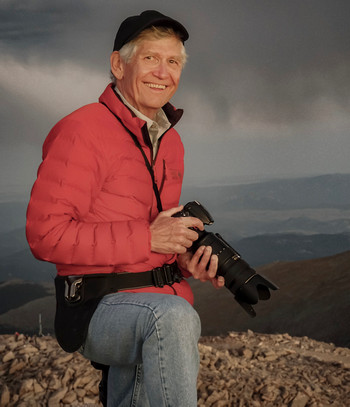
Photography, for me, is about seeing — not just looking. Long practice in seeing has made me realize that light and water have a way of transforming ordinary places into something worth pausing over.
My path to photography was anything but direct. A first career as a petroleum engineer took me to offshore drilling rigs around the world, where I had the rare privilege of observing landscapes and cultures most people never encounter. That way of seeing the world never left me. After earning my law degree in 1979, I spent more than thirty-five years practicing corporate law in Houston — but I kept observing.
In 2017, the mountains called. I relocated to Denver, where I continue my law practice while devoting serious time to photography. I start most mornings with a five-mile walk through the city, and weekends often find me on a trail, sometimes at a summit. Yoga, time in nature, and a discipline of quiet attention all feed into how I see and what I make.
My photography carries no commercial agenda, which is something of a gift. It means I can follow my instincts — toward long exposures, monochromatic interpretation, and the unhurried process of working an image until it reflects what I actually felt standing there. Finished prints sometimes represent ten to twenty hours of post-processing refinement. I think of the digital darkroom the way earlier artists thought of the analog one: not a correction step, but an essential part of making the work.
I came to photography without formal training in the medium, art history, or digital technology. Everything I know, I've built through reading, studying work I admire, and thousands of hours of practice. In recent years, workshops with visionary photographers — particularly Julia Anna Gospodarou, whose mastery of long-exposure technique has been a formative influence — have sharpened both my craft and my vision.
My artistic sensibilities have been shaped by a wide range of influences. I'm particularly drawn to the work of Eugene Atget, Frederick H. Evans, Michael Kenna, and Julia Anna Gospodarou, and the painter Paul Cézanne — artists who understood that restraint, patience, and a commitment to craft can produce images that outlast the moment.
Since 2025, I've taken a deliberate detour — setting the camera aside to explore drawing and painting in graphite, colored pencil, and watercolor. The Botanic Art and Illustration certificate program at the Denver Botanic Gardens and a regular nature journaling practice have become unexpected teachers, as have the many gifted instructors I've encountered along the way. Their generosity and expertise have sharpened the way I perceive light and shadow in ways I didn't anticipate. I believe that time spent creating art in other forms will eventually find its way back into the photography, enriching it in ways I'm only beginning to understand.
And yes — I do make one exception to the black-and-white rule. When I visit my six grandchildren in Texas, only color will do.
Also See: A Serendipitous Route To Becoming A Lawyer by Richard Lionberger published in the April/May 2020 issue of The Docket, a publication of the Denver Bar Association.
